
A brief discussion on the globalization of architectural education.
Ellefsen, K. O. (2020). Provincial and Outdated? A Brief Discussion on the Globalization of Architectural Education. EAAE Annual Conference Proceedings, 338–349. https://doi.org/10.51588/eaaeacp.72
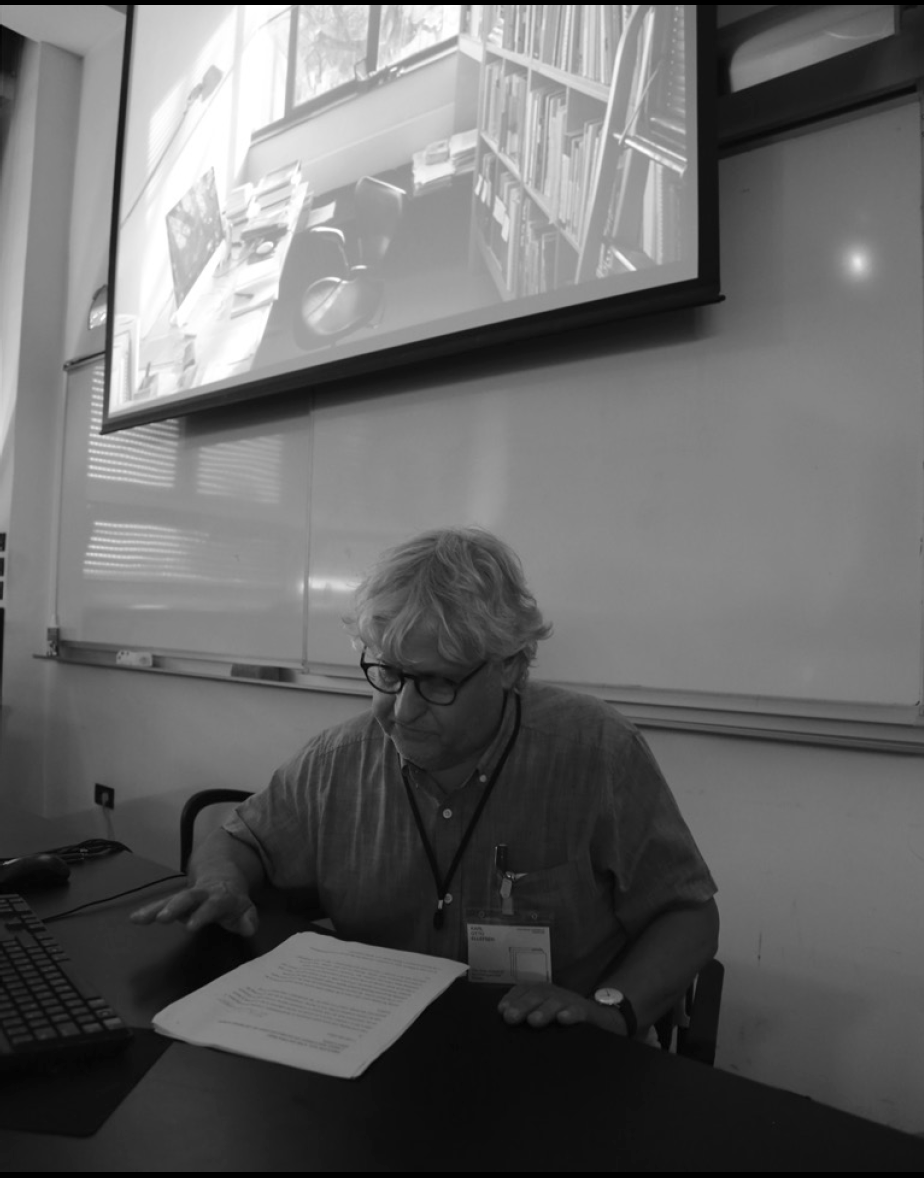
Karl Otto Ellefsen
Professor Oslo School of Architecture and Design
Professor Central Academy of Fine Arts Beijing
No global curriculum?
I am contributing with some small comments on the globalization of architectural education. After a life as a teacher, I know a lot of schools, but the reflections in this talk is based om my experiences from the Oslo School of Architecture (AHO) and my 10 years long involvement with the Central Academy of Fine Arts (CAFA) in Beijing. Globalization in this talk is denoting the general and “the hidden school” is a name for “the specificities”, often linked to school traditions and the reinterpretation of tradition.
During the twenty years I have been at the fringes of the EAAE, and in certain periods at the core of the EAAE system, the need for internationalization has been one of our main topics, reflecting the general European political agenda. I might remind you that the European Bologna Declaration was signed the 19th of June 1999, in 2019, twenty years ago. I have seen to that all the books coming out of the yearly EAAE symposiums are stored in our library, and consulting these, I find main headlines like, “Towards a common European Higher Architectural Education Area” (2002), “Bologna 10 years after” (2009), “What have we achieved, what have we lost?”, “Are we really more harmonized”. “Are we more transparent” etc.
In our event in Milan in 2015, we somehow concluded that the process of internationalization so far had not resulted in a “global studio” or a “global curriculum”. When the Bologna Process reforms came into effect some ten years ago, with the aim of making Europe’s variegated educational systems more compatible with one another, many believed that architectural training would become more uniform. But, our 2015 opinion was that schools rather tried to keep and develop their own identity, defining a “local” strategy to be able to cope with a “global situation”, to distinguish them and highlight their originality. Today I wonder if this conclusion was wrong. [1]
The hidden
The ”hidden” is hidden, not because somebody did hide it, but because we are not able to conceptualize it, or it might be so obvious that we do not think about it. My experience is also that this “hidden” is often talked about in rather one-dimensional terms, and not in its full complexity. Therefore the “hidden” might somehow vanish, normally not as a direct effect of a school policy, but as an unplanned, sometimes surprising side-effect of policies and strategies.
The complexity and differences in cultures, the countless incompatible languages and dialects, might be judged to be the most profound challenge to European cooperation, but this rather indigenous character is also a main European quality, distinguishing Europe from other parts of the world.
Architecture and urbanism as disciplines were international from the start. In Europe the disciplines merged with local vernacular traditions, interpreted modernism differently, unmounted modernistic practices in various ways, and developed different roles for the architect to perform in society.
Good schools are built by outstanding teachers. And architectural education is socially relevant and valid, linking to the culture and needs of a society. At least this was so in a small school close to the North Pole, started in 1945, right after the second World War as part of a process of rebuilding a nation. At the beginning education and practice merged entirely, teachers taught trough their projects, students won competitions for substantial public commissions before they graduated. After a while the Oslo-school was molded into a tradition, a little national romantic from the start, cherishing the thousand-year-old wooden way of building, and indulging in the Norwegian landscapes filled with local character of place. So far to the north that characteristics like “ahead of the game” or “mainstream” had little meaning. New concepts and ways had to travel far and took time.
In a country where pragmatic needs set the agenda, the school established a corrective, defending architecture as works of art, as “unicas” – one of a kind –, educating master builders who knew the terrain, with a sense of place, in a material tradition of wood, stone, brick and concrete, working with experimental tectonics. Four generation of teachers, the last three educated in the school. A small academy, entirely studio based.
“The hidden”, we did not even give it a name – the Oslo-school – until five or ten years ago. Before that it was mostly described as “Nordic architecture”. And indeed it was a tradition little written about, and even talked about by its great protagonists, When I was a student in the 1970s and the school tried to customize me into it, it seemed not to relate to a written language at all, you were mostly taught by the teachers drawings, his or her pictures, and occasionally some grunts describing tectonics and detailing.
How to describe the “hidden”? Maybe a more illustrative concept is “school culture”. Trying to break it down I would say we are talking about a:
(a) set of values, ways of understanding architecture linked to local architectural culture. The school has been a keeper and a of a tradition and an intuition renewing the tradition,
(b) strong linkages to society and local architectural practice. The school being “relevant” locally, nearly immerged in society,
(c) an academy, studio-based, established ways of working, both as a library and a laboratory,
(d) a generous and resource-rich teaching environment.
Schools of architecture stem from the same sources, and have been subject to international exchange of ideas from the very start, in terms of organization, pedagogy, curriculum and architectural inspirations and ideals. In the best schools translated and blended with local culture. Globalization of architectural culture should not be seen just as a further development of this situation, but as something entirely new: resulting in a global student marked (not limited to the schools with a tradition for international students), a global marked for young teachers trying to find positions to start out their academic careers, a need for proofs of quality situating schools in global rankings, a need for compatibility in terms of curriculum, and a vast, unlimited and always accessible gallery of world architecture. The schools had to reinvent themselves, using different kinds of coping strategies to adjust to and make the best out of the new frameworks.
Why do we not do something else?
During the 14 years I chaired AHO, we tried to develop strategies for the new situation.
We had been a school for building, but did indeed broaden our scope. With a certain success we developed our quality and capacity as a research institution and a producer of doctorates. And we – enthusiastically encouraged by the Norwegian ministry of education – were nearly possessed with being international. We were among the first Scandinavian universities to abandon local language for English in the doctoral school and the PhD theses, the very first to do all teaching on the master level in English, and to not demand that tenured teachers should be able to speak the local language. One of the outputs of course being that students from all over the world applied and that most of the professionals applying for PhDs and teaching positions are none-Scandinavian speaking.
When I left ship – without looking back – the policy seemed to have been a great success.
But most policies and strategies for change in due time display unforeseen consequences.
This spring, the journal of architecture, Arkitektur N, presented the three Norwegian Schools. of architecture. AHO under the headline: “The Oslo-school, Fehn and Norberg-Sculz is no longer defining for AHO. Now the school approaches the world, the working life and a contemporary understanding of what it is to be an architect.”
Here Thomas Mcquillan, dean of architecture, states – and I have no reason of suspecting him to give a false description of the Oslo school, he is an honest and intelligent man – that the school have no common architectural values. “We constitute a society with a common knowledge that we should be competitive and innovative.” For AHO the idea of an Oslo-school has been defining, but this has changed, he continues “ “There are more reasons for this, but an important factor is that we are an international community working and studying at the school, and we are generally more internationally oriented” ending a little embarrassingly with boasting benchmarking with Columbia and Harvard.[2]
Probably Mcquillan is right, a fundamental change in the school has occurred, and one of the main reasons for this are school policies, making the academic environment, entirely international, bringing in people with other, of course just as interesting values and practices, asking “why do we not do something else?”.
A loss or a needed full revision?
There are two main challenges to architecture and architectural education today. The first is to develop inventive approaches that might make the world more sustainable and avoid the worst parts of the coming break-down, the second is to develop practices that have “relevance”. The first is absolutely crucial, the second essential for the architect to regain and eventually expand her role in society.
Seen in this rather sombre context, does it really matter that the “hidden” is forgotten? Not necessarily, but it is certainly possible to put up an argument underlining that the school has lost something both valuable and relevant. Then we have to expand our superficial understanding of the “hidden”. A quote from one of the founders of the Oslo-school, Knut Knutsen, says: “search for the simple and the natural, the quiet and insignificant, the primordial and again the natural”.[3] Pointing towards values that were essential to the tradition; site-understanding, buildings merging with nature, humble expressions, short-travelled materials. The ability to identify the essential features of a specific place and then both utilize and respect them. An ethic stating that architects should accumulate an array of knowledge, impressions, and inspirations from the place and then synthesize them in a project that will be assessed and experienced through its highly tactile traits. In terms of pedagogy this means to strengthen the student’s sensitivity, to be able to critically familiarize themselves with program and local conditions. Working as though they are talking with and confiding in a friend.
The architects were educated for a specific task, to take part in local society and to provide tools for the modernization process. Every local society needs a dentist, and every town needs an architectural practice, knowing the terrain, able to culturally and socially communicate.
Like the very dentist, they knew their trade, their handicraft, as builders and planners or whatever. “Relevance” always means “Relevance to what”, and relevance in architecture most often means relevance to local society.
I like the concept “educational environment”, when we twenty years ago moved to our new localities, we were nearly frantic about the possibility of losing our school-culture. It turned out that the “hidden” was not carried by our premises, the old furniture that was thrown away, the administrative staff that was renewed, or the continuous stream of students. It was all about the teachers, and the researchers, how they are recruited and how they are selected.
The argument is not general. Many schools were from the start international and transcends more or less frictionless to be global. Others should not. We are only five million people speaking Norwegian, our national state is rather well functioning, and we indulge in the strangest activities like cross-country skiing and slow television. We are on the fringes of Europe, but has been culturally and economically part of the continent for a thousand years. We have always picked up inspiration from abroad, nearly everything we call Norwegian has been a translation of European ideas. I totally accept that an international teaching community do not merge into or is event professionally interested in this tradition. But we should not loose ourselves.
Will culture beat strategy, is there a ghost in the machine that simply cannot be removed? Or is the school transforming into something found anywhere in the world, and mostly mediocre?
[1] Karl Otto Ellefsen, “Architectural Education Towards 2030”. Key note speech, EAAE Congress 2015, 27-30 August.
[2] Arkitektur 6. 2018. «AHO, Fra Oslo–skolen til internasjonalt studiested» Interview with Thomas McQuillan by Gaute Brochmann.
[3] Poster text from the 1950s, reprinted in Knutsen/Tvedten, Knut Knutsen, Oslo: Gyldendal norsk forlag 1982, s.276. Translated by the author.


 Urbanism and Architecture – Karl Otto Ellefsen